They Sell Because They Cannot Market
Article

Marketing, branding, sales and public relations are different disciplines doing different jobs. Businesses that only sell do so because they have no brand and no marketing infrastructure — and without investment to break the cycle, they are the ones most exposed when costs rise or demand shifts.
Most businesses use the words sales, marketing, branding and public relations interchangeably. They are different disciplines doing different jobs, and the difference is not academic. It decides whether a business chooses its customers — or waits to be chosen, mostly on price.
The four disciplines
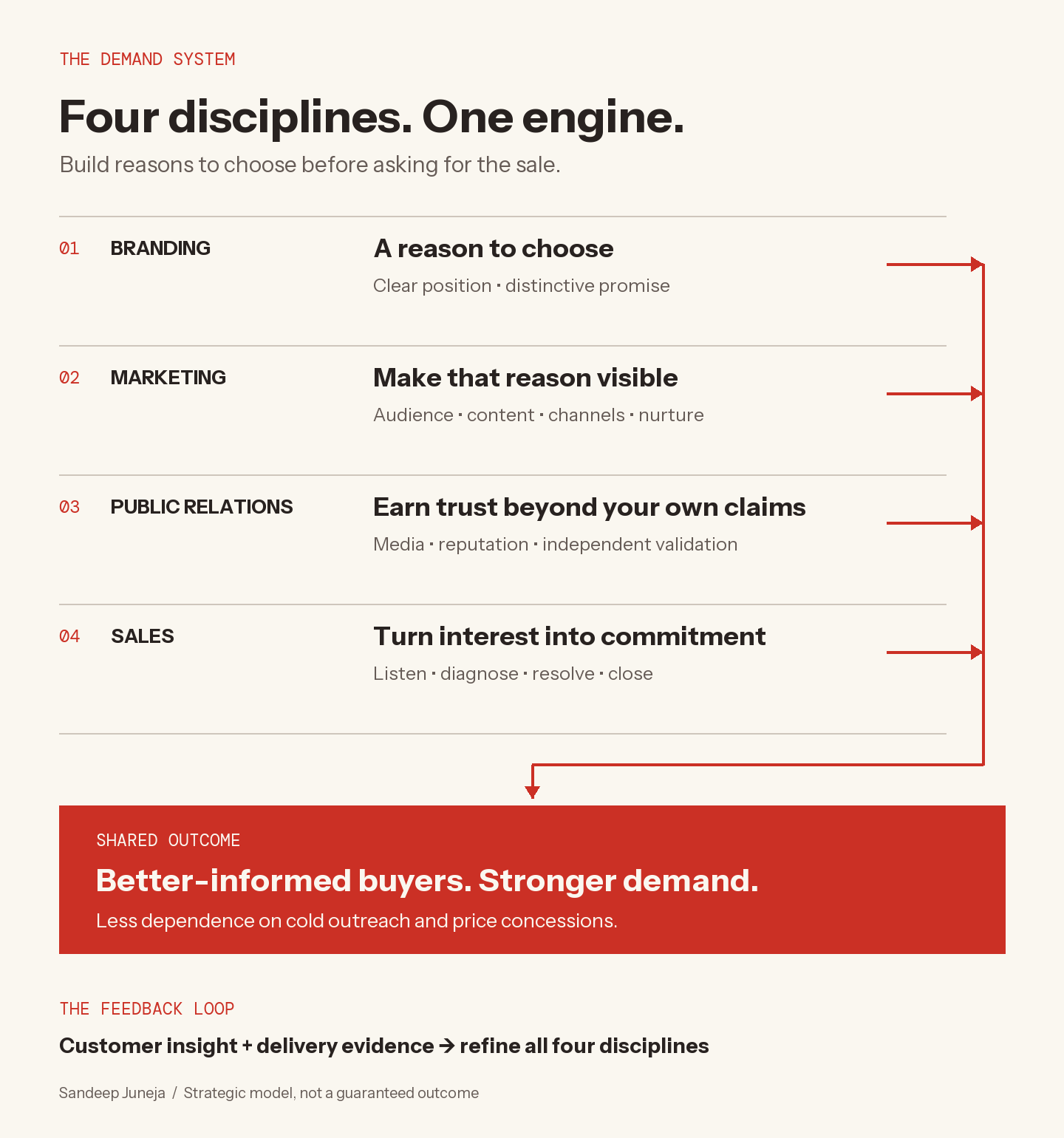
Branding answers the question: who are you? It is the deliberate construction of a reputation — the promise, personality and proof that make a business recognisable and preferable before a single conversation takes place. Branding works on memory and meaning, and it compounds over years.
Marketing answers: why should anyone care, and how do they find you? It is the infrastructure — research, segmentation, positioning, messaging, channels and campaigns — that creates and captures demand at scale. Marketing works on markets.
Sales answers: will you buy today? It is the one-to-one conversion of interest into revenue: prospecting, pipelines, proposals, negotiation and closing. Sales works on transactions.
Public relations answers: what do others say about you when you are not in the room? It earns third-party credibility through press coverage, awards and reputation among investors, regulators and peers. PR works on trust.
Selling is not a strategy
Watch a business that has none of the first three, and you will usually find one thing: it sells. It sells because it has to. Nobody knows who it is, so every order must be won personally. There is no pull, only pursuit.
Some say businesses that only sell do so because they have no brand and lack the marketing infrastructure — that they sell because they are unable to market. It is a hard observation, and a fair one. Selling is the symptom. The underlying condition is the absence of a position: no differentiated reason to choose them, no demand engine working while the team sleeps, no reputation arguing their case in the market.
The vulnerability of the seller-only business
A business that can only sell starts every month from zero. When a key salesperson leaves, the relationships leave with them. When a competitor undercuts, the only defence is matching the price. When a cost shock arrives — a tariff, a wage rise, a supply-chain break — the squeeze passes straight through to the bottom line, because there is no brand premium to absorb it and no marketing engine to find new demand.
Cost disruptions expose this fastest. The business with a brand keeps its price and keeps its customers, because the reason to choose it was never only the number. The seller-only business must discount to protect volume, and discounting a low-margin operation is a slow-motion retreat. The same applies when demand shifts: a marketing infrastructure can redirect attention, test new segments and reposition the offer. A sales-led business has no lever except more selling, harder, into a market that has stopped responding.
Breaking the cycle
Escaping the cycle requires investment, and it competes with payroll for the same money — which is exactly why it keeps being deferred. But the sequence is not mysterious.
First, decide the position: the ownable advantage the business will stand for. Second, build the marketing infrastructure: a clear message, chosen channels, a database of buyers and prospects, and content that keeps the position visible between transactions. Third, invest in reputation — case studies, coverage, accreditation and word of mouth that let others argue the business's case. Sales then becomes the last step of a system, not the only step of a desperate one.
Note: The argument in this article is strategic interpretation, not settled research. The four disciplines overlap in practice, and strong businesses run all four at once. But the pattern holds often enough to be worth acting on: a business that can market chooses its customers. A business that can only sell is chosen by the market — usually on price.
How the four disciplines build demand
Business self-assessment
Is selling carrying too much of the load?
Answer using evidence from the last 90 days, not planned activity. For a small business, one person can own several disciplines. Your answers stay on this page and are not sent or saved.